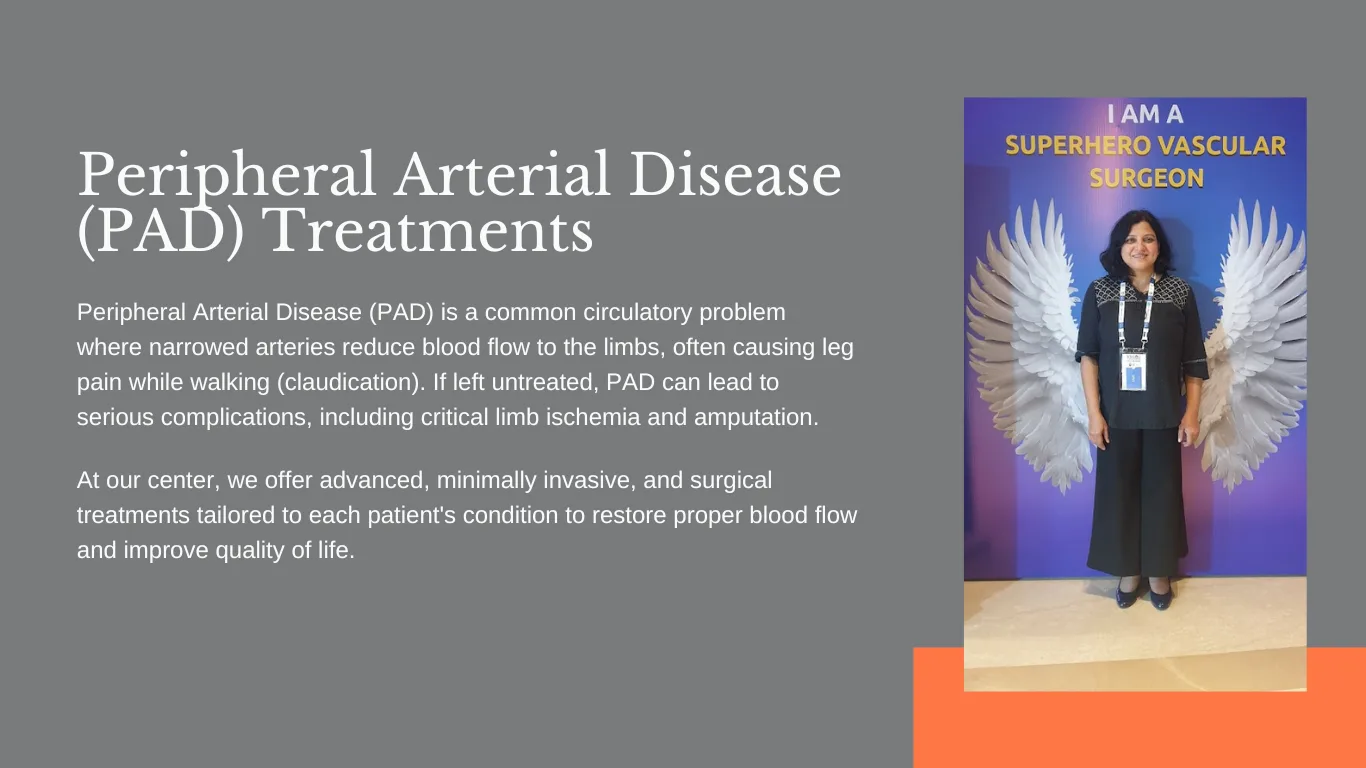
Peripheral Arterial Disease (PAD) Treatment Delhi: What It Involves
Peripheral Arterial Disease (PAD) develops when fatty deposits build up inside the arteries that supply blood to the legs, reducing blood flow to the muscles and tissues. As circulation becomes restricted, walking is often one of the first activities affected. Patients may experience leg pain, cramping, heaviness, or fatigue while walking, which may improve with rest. Peripheral arterial disease treatment in Delhi at Sir Ganga Ram Hospital covers a wide range of approaches, depending on disease severity and the patient's overall health.
Treatment may include a structured walking program, medicines and risk-factor management, and minimally invasive procedures such as angioplasty and stenting. In more advanced cases, bypass surgery may be required. Dr. (Col) Pranati Swain performs both endovascular and open vascular procedures. Many patients come after a diabetic foot wound has failed to heal, which is often the first sign that circulation is the underlying problem. Poor arterial blood flow can delay wound healing and, in severe cases, increase the risk of tissue damage and limb complications.
Symptoms
Common symptoms of peripheral arterial disease are:
- Pain while walking: Cramping pain in the calf, thigh, or buttock that starts after walking a certain distance and settles within a few minutes of rest. This is known as intermittent claudication and may be mistaken for age-related discomfort or knee pain.
- Foot pain at rest: Pain that wakes you at night and improves when you hang your leg over the edge of the bed may indicate severely reduced blood flow and put the limb at risk.
- Non-healing wounds: A wound on the foot or toe that does not heal properly may indicate poor circulation.
- Skin changes: Blackened skin or a foot that feels unusually cold and looks pale requires prompt medical attention.
- Subtle changes: Reduced hair growth on the shins, shiny skin, slow-growing toenails, numbness, and thinning of the calf muscles can also occur.
How PAD Is Diagnosed
The Ankle Brachial Pressure Index (ABPI) is commonly used as an initial test for peripheral arterial disease. It compares the blood pressure measured at the ankle with the pressure in the arm using a blood pressure cuff and Doppler device. The resulting reading helps identify reduced blood flow and indicates the severity of arterial narrowing. NICE guidance recommends checking leg pulses alongside ABPI as part of the PAD assessment.
When further evaluation is needed, duplex ultrasound can locate narrowed or blocked arteries and assess blood flow. CT angiography or MR angiography can provide detailed images of the blood vessels and help doctors plan procedures such as angioplasty or bypass surgery. In people with diabetes, stiff arteries may produce falsely elevated ankle pressure readings. Toe pressure measurements may therefore assess circulation more accurately.
Treatment Begins Before Any Procedure
One of the most important points for patients to understand is that treatment for intermittent claudication often begins with walking. NICE recommends a supervised exercise program for people with intermittent claudication, typically involving around two hours of exercise each week for three months. Patients are encouraged to walk until they reach their maximum pain level, rest until it settles, and then continue walking. Regular exercise can improve circulation by helping the body develop alternative pathways around narrowed arteries, allowing many patients to walk farther over time.
Medical management is also essential and can have a greater impact on long-term health than a vascular procedure. This includes stopping smoking, taking a statin and antiplatelet medicine when appropriate, controlling blood pressure, and maintaining good diabetes control. When exercise has not provided sufficient improvement, and the patient does not wish to undergo a procedure, NICE also recommends considering naftidrofuryl oxalate, with treatment reviewed after three to six months.
When a Procedure Is Recommended
Angioplasty is offered for claudication after risk factors have been addressed and a supervised exercise program has not delivered enough improvement. A balloon opens the narrowed segment, and a stent holds it open where the result needs support.
Bypass surgery comes in when angioplasty has not worked or does not suit the anatomy, and imaging confirms the leg is suitable. When a bypass is done, a vein from the patient's own leg is the preferred conduit, and NICE recommends using one whenever possible.
Critical limb ischemia is the urgent end of PAD: rest pain, tissue loss, or gangrene. NICE recommends that every patient at this stage be assessed by a vascular multidisciplinary team before treatment is decided, then treated with angioplasty or bypass depending on the pattern of disease, vein availability, and the patient's other conditions. Timing here is measured in days, not months.
After Treatment
Walking remains an important part of long-term PAD management, and prescribed medicines are usually continued for the long term because the underlying arterial disease can persist even after treatment. Follow-up may include a duplex ultrasound of the treated artery to check blood flow and identify any recurrent narrowing early. Detecting a problem on imaging can allow treatment before symptoms become severe. People with diabetes should also examine their feet every day and seek medical attention promptly for any new wound, rather than waiting to see whether it heals on its own. To discuss peripheral arterial disease treatment in Delhi, or to have leg pain or a non-healing wound assessed, book a consultation or call +91 98715 47888.
Angioplasty and Stenting
Angioplasty is a minimally invasive procedure used to open narrowed or blocked arteries. A small balloon is inserted through a catheter and inflated at the site of blockage to widen the artery. In many cases, a stent (a tiny wire mesh tube) is placed to keep the artery open and maintain blood flow. This procedure is commonly used for lower limb arteries affected by PAD and is often suitable for patients who want a quicker recovery than open surgery.
Benefits of Angioplasty & Stenting:
- Minimally invasive with quick recovery
- Restores blood flow and reduces pain
- Prevents progression to severe PAD stages
Atherectomy
Atherectomy is a specialized technique used to remove plaque buildup from the inside of the arteries. Using a catheter with a cutting device or laser, the hardened plaque causing blockage is physically removed to improve circulation. Atherectomy is particularly useful when arteries are too calcified or hard for simple balloon angioplasty.
Benefits of Atherectomy:
- Effective for heavily calcified arteries
- Restores blood flow without large incisions
- Can be combined with angioplasty or stenting for better outcomes
Bypass Surgery
For patients with severe arterial blockages that cannot be treated with angioplasty or atherectomy, bypass surgery may be recommended. This involves creating a new pathway for blood to flow around the blocked artery using either a synthetic graft or the patient’s own vein. Bypass surgery is highly effective in limb-saving situations and critical limb ischemia (CLI).
Benefits of Bypass Surgery:
- Effective for long and complex blockages
- Improves blood supply to prevent ulcers, wounds, and amputation
- Long-lasting solution for severe PAD
Why Choose Us for PAD Treatment?
- Assessment and personalized treatment planning by a vascular surgeon
- Endovascular and open surgical options performed by one surgeon
- Focus on limb preservation and quality of life improvement
- Experienced care under Dr. (Col) Pranati Swain, Vascular & Endovascular Surgeon, DNB (Peripheral Vascular Surgery)
If you or a loved one has symptoms of PAD such as leg pain, cramping, or non-healing wounds, early peripheral arterial disease treatment in Delhi can prevent serious complications.
Contact us today for evaluation and treatment: drpranatiswain@gmail.com
Frequently asked questions
Can peripheral arterial disease be reversed?
Should I walk if it hurts?
What is a normal ankle-brachial pressure index?
Will I need a stent?
Does PAD always lead to amputation?
How is PAD different from varicose veins?
Medically reviewed by Dr. (Col) Pranati Swain, MBBS, MS (General Surgery), DNB (Peripheral Vascular Surgery) · Last reviewed 29 Sep 2026
The information on this page is for general education and is not a substitute for professional medical advice, diagnosis or treatment. Outcomes vary between patients — always consult a qualified clinician about your own condition. If you have a medical emergency, call your local emergency number immediately. Read the full disclaimer.