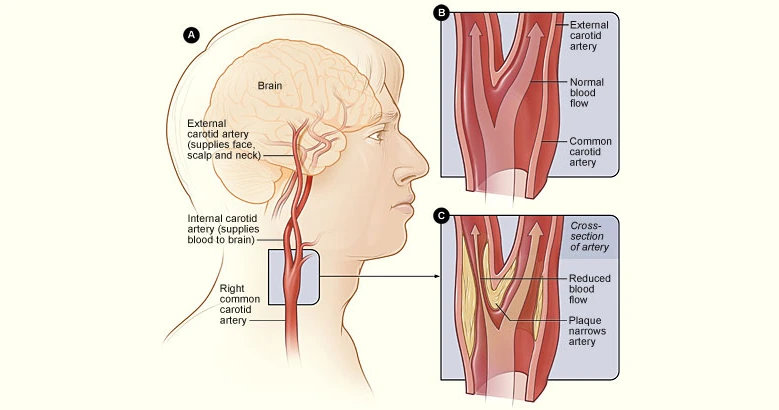
The carotid arteries are the two large arteries on either side of the neck that carry blood to the brain. When fatty plaque builds up inside them, the artery narrows. This is carotid artery disease, and it is an important cause of stroke.
A carotid artery blockage usually causes no symptoms until a fragment of plaque or a blood clot breaks away and travels to the brain. Sometimes the first sign is a brief warning episode; sometimes it is a stroke. This article explains the warning signs, how doctors diagnose carotid narrowing, and how they decide between medicines, surgery, and stenting.
What Is a Carotid Artery Blockage?
Plaque is a build-up of cholesterol, fat, calcium and other material in the artery wall that develops over many years, a process called atherosclerosis. In the carotid arteries, it tends to form where each artery divides in the neck into two branches: the internal carotid artery, which supplies the brain, and the external carotid artery, which supplies the face and scalp.
Doctors describe carotid artery blockage as a percentage, indicating how much the artery has narrowed at its most restricted point. The main concern is not always reduced blood flow, as the brain receives blood from several arteries. Instead, plaque can rupture or develop clots that travel to the brain and block smaller blood vessels, potentially causing a stroke.
Who Is at Risk?
Carotid artery disease is more likely in people who:
- Are older
- Smoke, or used to smoke
- Have high blood pressure
- Have high cholesterol
- Have diabetes
- Already have narrowed arteries elsewhere, such as coronary artery disease or peripheral arterial disease
- Have a family history of stroke or artery disease
- Are overweight or physically inactive
People with narrowed arteries in the heart or legs are more likely to also have carotid narrowing, because the same process affects arteries throughout the body.
Symptoms of Carotid Artery Blockage
Most people with carotid artery narrowing have no symptoms. A doctor may discover it during a routine examination when they hear a whooshing sound, known as a bruit, over the neck, or during an imaging scan performed for another reason. When symptoms occur, they are usually related to a transient ischaemic attack (TIA) or stroke.
Transient ischaemic attack (TIA)
A transient ischaemic attack (TIA), sometimes called a mini-stroke, occurs when the blood supply to part of the brain is temporarily interrupted. Symptoms can last for a few minutes to several hours and usually resolve completely within 24 hours. They may include:
- Sudden weakness, numbness, or tingling on one side of the face or body
- Sudden loss of vision in one or both eyes
- Slurred speech, or difficulty speaking or understanding others
A TIA is a warning. It shows that the risk of a full stroke in the near future is raised, which is why it must be treated as an emergency even though the symptoms go away.
Stroke
In a stroke, symptoms usually do not go away on their own and require immediate medical attention. The main warning signs can be remembered using the word FAST:
- Face: One side of the face may droop, and the person may be unable to smile normally.
- Arms: The person may be unable to raise both arms or keep one arm raised because of weakness or numbness.
- Speech: Their speech may be slurred or unclear, or they may have difficulty speaking or understanding speech.
- Time: Call 112 immediately if any of these signs appear. Prompt treatment can be critical.
How Carotid Artery Disease Is Diagnosed
Doctors diagnose carotid artery disease through a physical exam, medical history review, and specialized imaging tests to check for narrowed blood vessels.
Carotid duplex ultrasound
The first test is usually a carotid duplex ultrasound. A probe is gently moved over the neck to produce images of the artery walls and measure blood flow through any narrowed areas. The blood-flow speed helps doctors assess the severity of the narrowing. The test is non-invasive and uses neither radiation nor contrast dye.
CT or MR angiography
If an ultrasound shows significant narrowing or a procedure is being considered, CT angiography (CTA) or MR angiography (MRA) can provide detailed images of the carotid arteries and the blood vessels supplying the brain. These scans help confirm the severity and location of the narrowing and guide treatment planning.
Other tests after a TIA or stroke
People who have experienced a TIA or stroke will usually undergo additional tests, including a brain scan, an electrocardiogram (ECG) to check heart rhythm, and blood tests to assess cholesterol and diabetes. These tests help identify other possible causes and guide appropriate treatment.
Treatment Options for Carotid Artery Blockage
The aim of treatment is to prevent a stroke. The right option depends mainly on whether the narrowing has caused symptoms, how severe it is, and your overall health.
| Situation | Usual approach |
|---|---|
| Narrowing without symptoms | Medicines and risk-factor control, with regular ultrasound checks; a procedure may be considered for severe narrowing |
| Recent TIA or minor stroke, with less than 50% narrowing | Medicines and risk-factor control; surgery is not recommended |
| Recent TIA or minor stroke, with 50–99% narrowing | Urgent assessment for carotid endarterectomy, together with medicines |
The percentages in this table follow the NASCET measurement method used in NICE guidance.
Medical treatment
Everyone with carotid artery disease needs medical treatment, whether or not they also have a procedure. This usually includes:
- Antiplatelet medicine, such as aspirin or clopidogrel, to reduce clotting
- A statin to lower cholesterol
- Blood pressure control
- Good control of diabetes
- Stop smoking, regular physical activity and a healthy diet
Taking prescribed medicines consistently and maintaining healthy lifestyle habits can help reduce the risk of stroke and heart attack. Do not stop taking antiplatelet medicines without first speaking with your doctor.
Carotid endarterectomy
Carotid endarterectomy is a surgical procedure used to remove plaque from a narrowed carotid artery. The surgeon makes an incision in the side of the neck, opens the affected artery, removes the plaque from its inner lining, and then closes the artery, often using a patch to widen it. The procedure can be performed under general or local anesthesia.
For people who have had a TIA or minor stroke caused by significant carotid artery narrowing, carotid endarterectomy is often recommended promptly after the event. This is because the risk of another stroke is higher during the first days and weeks following a TIA or minor stroke.
Carotid artery stenting
In carotid artery stenting, a thin tube (catheter) is passed through an artery, usually in the groin, up to the narrowed carotid artery. A small protection device may be used to catch any debris, and a mesh tube called a stent is expanded to hold the artery open. Stenting avoids an incision in the neck.
Stenting may be considered when surgery carries a higher risk. Examples include previous surgery or radiotherapy to the neck, narrowing in a position that is hard to reach surgically, and serious heart or lung disease that makes an operation riskier.
Choosing between surgery and stenting
Both procedures aim to lower the future risk of stroke, and both carry risks of their own, including a small risk of stroke during or soon after the procedure. Endarterectomy can also cause hoarseness or numbness around the incision, which usually improves with time. Stenting can cause bleeding or bruising where the catheter was inserted. Your vascular surgeon will explain which approach suits your anatomy, health, and preferences, and why.
What If Your Blockage Has No Symptoms?
Many cases of carotid artery narrowing are discovered incidentally and can initially be managed with medical treatment. The Society for Vascular Surgery notes that surgery may be considered when narrowing exceeds 60%, in addition to medical therapy. The decision depends on the degree of narrowing, other stroke-risk factors, overall health, and life expectancy.
Doctors weigh the potential benefits of treatment over the following years against the immediate risks of a procedure. Doctors may use regular ultrasound scans to monitor whether the narrowing is progressing. Report any new symptoms promptly rather than waiting for the next scheduled scan.
Recovery and Follow-Up
After carotid endarterectomy, the neck is usually sore and may be swollen for a few days, and numbness around the scar can take longer to settle. After stenting, there may be bruising where the catheter was inserted. Most people return to normal daily activities within a couple of weeks, and your surgeon will advise when you can drive again.
Follow-up usually includes:
- An ultrasound scan to check the treated artery, and periodic checks of the artery on the other side
- Long-term antiplatelet and cholesterol-lowering medicines, unless you are advised otherwise
- Continued control of blood pressure, diabetes and smoking
Reducing Your Risk of Stroke
Whether or not you need a procedure, these steps matter most:
- Stop smoking, with support if you need it
- Take your medicines every day as prescribed
- Keep blood pressure, cholesterol and blood sugar within the targets your doctor sets
- Stay physically active, with regular moderate exercise
- Eat a diet low in saturated fat and salt, with plenty of vegetables, fruit and whole grains
- Limit alcohol
- Learn the FAST signs, and make sure your family knows them too
Carotid Artery Disease Treatment in Delhi
Dr. (Col) Pranati Swain is a vascular & endovascular surgeon at Sir Ganga Ram Hospital, New Delhi. She evaluates carotid narrowing, reviews ultrasound and CT scans, and advises on medical treatment, carotid endarterectomy, and carotid artery stenting. Find out more about carotid artery disease treatment in Delhi.
If a scan has shown carotid narrowing, or you have had symptoms that went away, book a consultation or call +91 98715 47888. If symptoms are happening now, call 112 instead. You can also read about other warning signs that mean you should see a vascular surgeon.
Frequently Asked Questions
Can a carotid artery blockage be reversed?
Plaque usually doesn't disappear completely, but medicines and lifestyle changes can slow its progression and reduce stroke risk. For significant symptomatic narrowing, carotid endarterectomy can remove plaque, while stenting helps keep the narrowed artery open.
What percentage of carotid blockage needs surgery?
It depends on whether the narrowing has caused symptoms. NICE guidance recommends urgent assessment for surgery when a TIA or minor stroke is linked to 50–99% narrowing, measured by the NASCET method. Without symptoms, the decision is individual and depends on how severe the narrowing is, your overall health, and your life expectancy.
Can you feel a blocked carotid artery?
No. You can't feel carotid narrowing, and most people have no symptoms. A doctor may hear a whooshing sound (a bruit) through a stethoscope, but an ultrasound scan is needed to confirm and measure the narrowing.
Is dizziness a sign of carotid artery blockage?
Dizziness is rarely caused by carotid artery disease. It more often has other causes, such as inner ear problems, low blood pressure, or medicine side effects. Carotid symptoms are usually sudden and affect one side: weakness, numbness, loss of vision, or difficulty speaking. Dizziness, along with any of these, needs emergency care.
How long does recovery take after carotid surgery?
Most people stay in hospital for a short time and return to light daily activities within one to two weeks. The neck may feel sore or numb for several weeks. Your surgeon will advise on driving, going to work, and exercise based on your recovery.
Medically reviewed by Dr. (Col) Pranati Swain, MBBS, MS (General Surgery), DNB (Peripheral Vascular Surgery) · Last reviewed 1 Oct 2026
The information on this page is for general education and is not a substitute for professional medical advice, diagnosis or treatment. Outcomes vary between patients — always consult a qualified clinician about your own condition. If you have a medical emergency, call your local emergency number immediately. Read the full disclaimer.