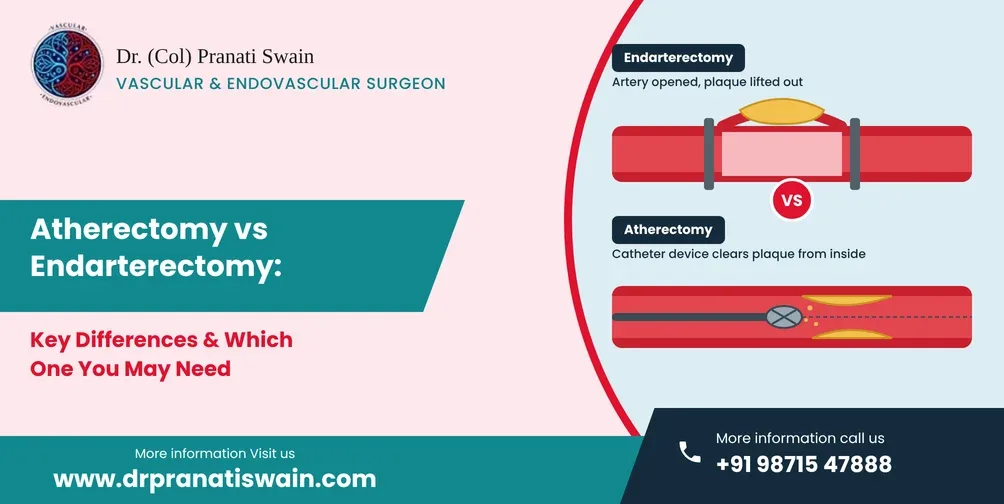
Atherectomy and endarterectomy both remove plaque from a narrowed artery, but in different ways. Endarterectomy is open surgery: the surgeon opens the artery through a cut and lifts the plaque out. Atherectomy works from inside the artery through a needle puncture, using a catheter device that shaves, cuts or sands away plaque, often in peripheral arterial disease.
Which one suits you depends mostly on which artery is blocked. In the neck, the standard choices are carotid endarterectomy or a stent, not atherectomy. In the groin, endarterectomy is often preferred. In the thigh and below the knee, atherectomy is one option among several catheter treatments. This guide is reviewed by Dr (Col) Pranati Swain, a vascular and endovascular surgeon at Sir Ganga Ram Hospital, New Delhi, who performs both open and catheter-based procedures. Results vary between patients.
Atherectomy vs endarterectomy at a glance
| Endarterectomy | Atherectomy | |
|---|---|---|
| Type of procedure | Open surgery | Minimally invasive, catheter-based (endovascular) |
| How plaque is removed | Artery is opened and the plaque is peeled out with the inner lining | A device inside the artery cuts, shaves, sands or vaporises the plaque |
| Access | A cut over the artery (neck or groin) | A needle puncture, usually in the groin |
| Anaesthesia | General, regional or local anaesthesia | Usually local anaesthesia with light sedation |
| Main arteries treated | Carotid artery in the neck; common femoral artery in the groin | Thigh and below-knee leg arteries, especially hard, calcified plaque |
| Used in the carotid artery? | Yes, a standard treatment | Not a routine carotid treatment |
| Usually combined with | A patch to close and widen the artery | Balloon angioplasty, a drug-coated balloon or a stent |
| Typical hospital stay | About 1 to 3 days | Often day care or one night |
| Scar | A visible scar of a few centimetres | A small puncture mark |
What is endarterectomy?
Endarterectomy is an open operation that removes plaque from inside an artery. The surgeon makes a cut over the artery, clamps it above and below the narrowing, opens it lengthways and lifts out the plaque together with the diseased inner lining. The artery is then closed, often with a patch that keeps it wide, and blood flow is restored.
Because the plaque is taken out completely rather than pushed aside, endarterectomy gives a clear view of the disease and leaves a smooth inner surface. It is a long-established operation, and its results have been studied for decades.
Surgeons use endarterectomy mainly in two arteries:
- Neck (carotid endarterectomy): this reduces future stroke risk when the carotid artery is badly narrowed. It is offered most often after a transient ischaemic attack (TIA), also called a mini-stroke, or after a minor stroke on the same side.
- Groin (femoral endarterectomy): this eases leg pain on walking or helps a foot wound heal. The common femoral artery bends with every step, which makes stents there less reliable, so open endarterectomy is often favoured.
What is atherectomy?
Atherectomy is a catheter procedure that removes plaque from inside an artery without opening it. A thin tube is passed into the artery through a needle puncture, usually in the groin, and guided to the blockage on live X-ray. A small device at the tip then breaks down the plaque, and the debris is either collected by the device or carried away in tiny particles.
There are four main kinds of atherectomy device:
- Directional atherectomy: a small blade shaves plaque from the artery wall and stores it in the catheter tip.
- Rotational atherectomy: a fast-spinning burr grinds the plaque into very fine particles.
- Orbital atherectomy: a weighted crown orbits inside the artery and sands down hard, calcified plaque.
- Laser atherectomy: pulses of laser light vaporise the plaque.
Atherectomy is rarely used on its own. It usually prepares a hard or calcified artery so that a balloon, a drug-coated balloon or a stent can then open it more fully. It is used mainly in the arteries of the thigh and below the knee.
Is atherectomy better than angioplasty alone?
Not clearly. A Cochrane review found that atherectomy performs about the same as balloon angioplasty, with or without a stent, for leg arteries, but the evidence was weak and the finding is uncertain. That is why many vascular surgeons use atherectomy selectively rather than routinely.
It is most often chosen when calcium would stop a balloon from opening the artery properly, or when a stent is better avoided, for example behind the knee. The UK's National Institute for Health and Care Excellence (NICE) has also published guidance on plaque-excision atherectomy for thigh arteries.
What is the main difference between atherectomy and endarterectomy?
The main difference is how the surgeon reaches the plaque. Endarterectomy opens the artery from the outside and removes the plaque in one piece under direct vision. Atherectomy reaches the plaque from inside the artery through a puncture and removes it bit by bit with a device, guided by X-ray.
That difference shapes almost everything else:
- Recovery: after atherectomy most people walk the same day and go home within a day. After endarterectomy, a short hospital stay and a healing wound are expected.
- Where each works: endarterectomy suits short, focal plaque in arteries a surgeon can reach easily, such as the neck and groin. Atherectomy suits longer, deeper arteries in the leg that are hard to reach with open surgery.
- Anaesthesia: endarterectomy may need general or regional anaesthesia; atherectomy is usually done under local anaesthesia.
- Further treatment: endarterectomy is usually complete in itself. Atherectomy is usually followed, in the same sitting, by balloon angioplasty or a stent.
Where is each procedure used?
Each procedure has its own place in the body. Endarterectomy is used mainly in the carotid artery in the neck and the common femoral artery in the groin. Atherectomy is used mainly in the arteries of the thigh and below the knee, especially when the plaque is hard and calcified. The sections below explain how the choice works in each area.
For the carotid artery
For a narrowed carotid artery, the real choice is between carotid endarterectomy and carotid stenting, not atherectomy. Atherectomy is not a routine carotid treatment because loose plaque fragments in the neck can travel to the brain and cause a stroke.
Carotid endarterectomy is advised mainly for people who have had a TIA or minor stroke and have a significant narrowing on the same side. NHS guidance notes that the operation is most effective when it is done soon after symptoms, ideally within two weeks. People with a narrowing but no symptoms are assessed one by one, since medicines alone may be enough for some.
Carotid stenting, done through a puncture, may be considered when surgery in the neck is harder, for example after earlier neck surgery or radiotherapy, or when the narrowing is very high in the neck. Read our full guide to carotid endarterectomy vs carotid stenting.
For the leg arteries
In the legs, the choice depends on which segment of the artery is blocked. The groin, the thigh and the arteries below the knee each behave differently, so one method does not fit every leg.
- Groin (common femoral artery): open femoral endarterectomy is often the first choice. European vascular guidelines generally favour it here because the artery is close to the skin, easy to reach and moves with the hip, which can damage stents.
- Thigh (superficial femoral and popliteal arteries): balloon angioplasty, drug-coated balloons and stents are the usual tools. Atherectomy may be added when the plaque is very hard, so the balloon can open the artery evenly. For long, complex blockages in fit patients, a bypass may be discussed instead.
- Below the knee (tibial arteries): these arteries are small and often heavily calcified, especially in people with diabetes. Atherectomy is sometimes used here before angioplasty, mainly to save a limb with a non-healing wound.
- Combined (hybrid) treatment: a surgeon may perform a groin endarterectomy and, in the same sitting, treat a blockage further down the leg through the same opening. Learn more about hybrid and complex endovascular procedures.
How is each procedure done?
Endarterectomy is done through a cut of a few centimetres over the artery, usually under general, regional or local anaesthesia, and takes about one to two hours. Atherectomy is done through a needle puncture in the groin under local anaesthesia, guided by X-ray, and also takes about one to two hours. The steps for each are below.
Steps in a carotid or femoral endarterectomy
- You receive general, regional or local anaesthesia, depending on the artery and your health.
- The surgeon makes a cut of a few centimetres over the artery in the neck or groin.
- A blood thinner is given and the artery is clamped above and below the plaque. In the neck, a small temporary tube (shunt) may keep blood flowing to the brain.
- The artery is opened lengthways and the plaque is lifted out with the diseased inner layer.
- The artery is closed, usually with a patch, and the clamps are released.
- The wound is closed, and you are watched closely for a few hours afterwards.
Steps in an atherectomy
- You receive local anaesthesia at the puncture site, with light sedation if needed.
- A thin sheath is placed in the artery, usually in the groin.
- Contrast dye and live X-ray (angiography) show the blockage.
- A guidewire is passed across the narrowing, and a filter may be placed beyond it to catch loose debris.
- The atherectomy device removes or breaks down the plaque.
- A balloon, drug-coated balloon or stent is usually used next to fully open the artery.
- The sheath is removed and the puncture is sealed with pressure or a closure device.
What are recovery and risks like for each?
Recovery is quicker after atherectomy because there is no open wound. Most people walk the same day, go home within a day and return to light activity within a few days. After endarterectomy, a stay of one to three days is common, and the wound usually heals over two to four weeks. Both carry some risk, which depends on your health and the artery treated.
Recovery after atherectomy
- Bed rest for a few hours to protect the puncture site
- Light walking the same day or the next morning
- No heavy lifting for about a week
- Blood-thinning medicines as advised, often for several months
- A follow-up check, and often a duplex ultrasound scan, to confirm the artery stays open
Recovery after endarterectomy
- A short hospital stay for wound and blood pressure checks
- Some neck or groin discomfort and swelling for a week or two
- No driving until you can turn your head or move your leg freely and your doctor agrees
- Blood-thinning and cholesterol-lowering medicines, usually for life
- A follow-up visit to check the wound, and a scan of the artery later
Whichever procedure you have, the plaque came from atherosclerosis, which affects arteries throughout the body. Stopping smoking, walking regularly and keeping blood pressure, sugar and cholesterol under control protect the treated artery and the rest of the circulation over time.
Possible risks of endarterectomy
- Stroke or mini-stroke, mainly with carotid surgery
- Bleeding, or a collection of blood under the skin
- Infection, especially in the groin
- Temporary numbness of the skin near the scar
- Nerve irritation in the neck, causing a hoarse voice or difficulty swallowing that usually settles
- Heart problems during or after surgery
- The artery narrowing again over time
Possible risks of atherectomy
- Bleeding or bruising at the puncture site
- Small pieces of plaque travelling further down the leg (distal embolism)
- A tear or, rarely, a hole in the artery wall
- A sudden clot in the treated artery
- Kidney strain from the X-ray contrast dye
- The artery narrowing again, which may need a repeat procedure
Which procedure is right for you?
The right procedure depends on the artery involved, the length and hardness of the blockage, your symptoms and your general health. No single option suits everyone, and some patients do well with medicines and a walking programme alone.
You may be offered endarterectomy if:
- You have had a TIA or minor stroke and have a significant narrowing in the carotid artery on the same side
- The blockage is in the common femoral artery in the groin
- The plaque is short and easy to reach through a small cut
- You are fit enough for a short operation
You may be offered atherectomy, usually with angioplasty, if:
- The blockage is in the thigh or below-knee arteries
- The plaque is very hard or calcified, so a balloon alone may not open it well
- You have a non-healing foot wound or early gangrene and need blood flow restored
- Open surgery would carry a higher risk because of heart or lung disease
Medicines and lifestyle measures alone may be enough if:
- Your narrowing is mild or causes no symptoms
- Leg pain on walking is stable and does not limit daily life
- There is no wound, rest pain or tissue loss
A duplex ultrasound scan and, where needed, a computed tomography (CT) angiogram show exactly where the blockage is and how hard it is. Those images, more than the name of the procedure, decide the plan.
What do patients often worry about?
Patients most often ask whether the artery will block again, whether they will need a stent for life, and how soon they can walk or drive. The honest answer is that it depends on the artery and on how well risk factors are controlled afterwards. Asking your surgeon to show you the scan, explain why one method was chosen over another and write down the follow-up plan helps you feel sure of the decision.
When should you see a vascular surgeon?
See a vascular surgeon if calf, thigh or buttock pain comes on with walking and eases with rest, if your foot hurts at night or at rest, if a foot or leg wound is not healing, or if a scan has shown a carotid narrowing. A review is also useful if you have been advised endarterectomy, atherectomy or stenting and want a second opinion on your scans.
Call 112 or go to the nearest emergency department at once if you notice sudden face drooping, arm weakness, slurred speech or sudden loss of vision. These can be signs of a stroke. A suddenly cold, pale, painful leg also needs emergency care.
Dr (Col) Pranati Swain holds an MBBS, an MS in General Surgery and a DNB in Peripheral Vascular Surgery, has more than 20 years of surgical experience and was the first woman vascular surgeon in the Indian Armed Forces. She performs open operations such as endarterectomy and bypass, and catheter treatments such as angioplasty and stenting. If you would like your scans reviewed, you can book a consultation at Sir Ganga Ram Hospital, Old Rajinder Nagar, New Delhi 110060, or call +91 98715 47888.
Frequently asked questions
Is atherectomy the same as endarterectomy?
No. Both remove plaque, but endarterectomy is open surgery in which the artery is cut open and the plaque lifted out. Atherectomy is a catheter procedure done through a needle puncture, in which a device breaks down the plaque from inside the artery without opening it.
Is atherectomy used for carotid artery blockage?
Atherectomy is not a routine treatment for the carotid artery, because loose plaque fragments could travel to the brain and cause a stroke. A narrowed carotid artery is usually treated with carotid endarterectomy, carotid stenting or medicines alone, depending on symptoms and the degree of narrowing.
Which is less invasive, atherectomy or endarterectomy?
Atherectomy is less invasive. It is done through a small puncture, usually under local anaesthesia, and most people go home within a day. Endarterectomy needs a cut over the artery and a short hospital stay, although it is still a focused operation that usually takes one to two hours.
What is the difference between endarterectomy and thrombectomy?
Endarterectomy removes hardened plaque that has built up in the artery wall over years. Thrombectomy removes a fresh blood clot that has suddenly blocked an artery or vein, either through a cut or with a catheter device. Thrombectomy is usually an emergency procedure, while endarterectomy is usually planned.
How long does recovery take after endarterectomy?
Most people stay in hospital for one to three days after an endarterectomy. Light daily activity usually resumes within a week or two, and the wound typically heals over two to four weeks. Your surgeon will advise when you can drive, lift and return to work.
Can a blocked artery come back after atherectomy or endarterectomy?
Yes, the treated artery can narrow again after either procedure, and new plaque can form elsewhere. Taking prescribed medicines, stopping smoking, staying active and attending follow-up scans lower that chance. If narrowing returns, it can often be treated again.
Does atherectomy need a stent afterwards?
Not always. Atherectomy is usually followed by balloon angioplasty, often with a drug-coated balloon, and a stent is added only if the artery does not stay open well. In joints such as behind the knee, surgeons often try to avoid a stent where possible.
Sources
These sources support the medical facts above, including the timing of carotid surgery and the evidence on atherectomy:
- NHS: Carotid endarterectomy
- Cochrane: Is atherectomy in leg arteries better than other minimally invasive treatments?
- NICE: Percutaneous atherectomy of femoropopliteal arterial lesions with plaque excision devices
Medically reviewed by: Dr (Col) Pranati Swain (MBBS; MS, General Surgery; DNB, Peripheral Vascular Surgery), Vascular and Endovascular Surgeon
Last updated: November 2026
Medical disclaimer: This information is for general guidance only and is not medical advice. Treatment decisions and results vary between patients. In an emergency, call 112.
Medically reviewed by Dr. (Col) Pranati Swain, MBBS, MS (General Surgery), DNB (Peripheral Vascular Surgery) · Last reviewed 24 Nov 2026
The information on this page is for general education and is not a substitute for professional medical advice, diagnosis or treatment. Outcomes vary between patients — always consult a qualified clinician about your own condition. If you have a medical emergency, call your local emergency number immediately. Read the full disclaimer.